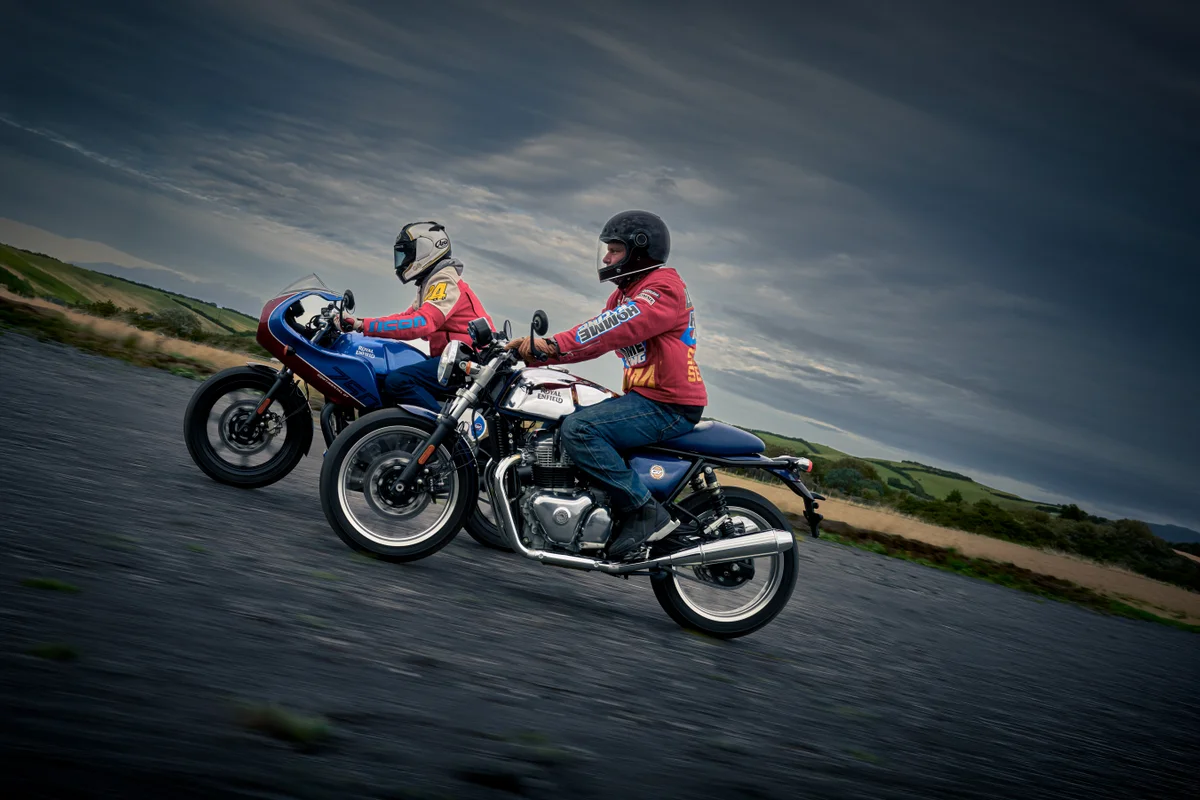
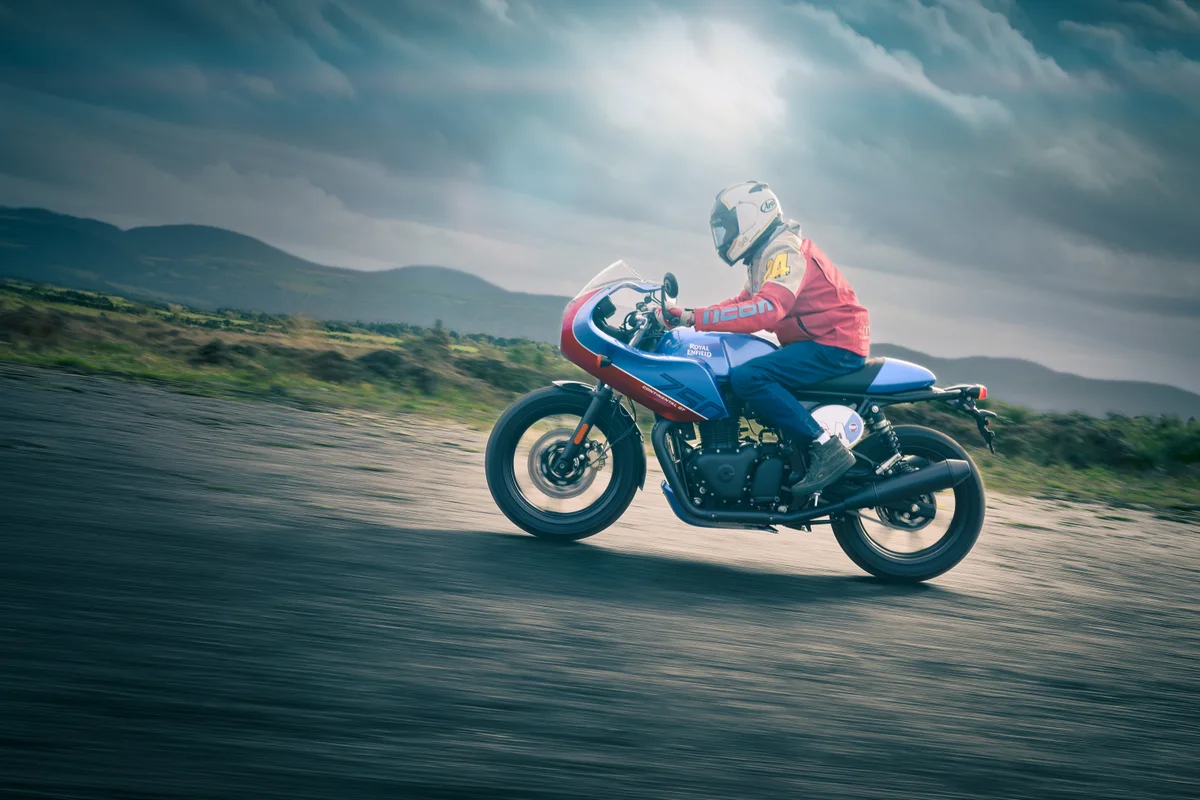
Royal Enfield has brought the Continental GT 750 to EICMA in Milan. It is the brand's new cafe racer and, by its own account, its highest-performance production motorcycle to date. It takes over from the Continental GT 650, one of the best-selling factory cafe racers of recent years, with a new 743 cc twin and two versions: faired and unfaired.
A 743 cc engine
At its heart is the 743 cc parallel twin that launches Royal Enfield's 750 platform, the same engine as the new Himalayan 750. In its known form it makes 55 hp at 7,000 rpm and 63 Nm at 5,000 rpm, but the brand has not yet given final figures for the Continental, so they may change. What we know is that it has a six-speed gearbox with gearing revised for sportier riding; it will most likely keep the assist and slipper clutch.
Faired and unfaired
There are two versions. The faired one gets a racing-style fairing and lower bars, for a riding position tucked over the tank. The naked one keeps the classic GT silhouette, the one we all picture when we think of a factory cafe racer. Both share a single seat with a removable cowl.
There are three colour schemes, spread across the two versions:
- Red Line: red, with chrome spoked wheels.
- TT Blue: a Tourist Trophy-inspired blue, with alloy wheels and tubeless tyres.
- Master Clean: chrome tank with blue details and spoked wheels.
Chassis and equipment
- Wheels: 18-inch. Spoked with tubed Vredestein Centauro ST tyres on Red Line and Master Clean; alloy and tubeless on TT Blue.
- Suspension: conventional telescopic fork and twin rear shocks, adjustable for preload.
- Brakes: twin front discs and a single rear disc, carried over from the Himalayan 750.
- Instruments: twin dials with an integrated TFT screen, with a deliberately analogue feel.
- Exhaust: two silencers, one on each side, as GT tradition demands.
Spec sheet (provisional)
| Engine | 743 cc parallel twin |
|---|---|
| Power and torque | Not confirmed (the platform makes 55 hp at 7,000 rpm and 63 Nm at 5,000 rpm) |
| Gearbox | Six-speed |
| Suspension | Telescopic fork and twin shocks, preload-adjustable |
| Brakes | Twin front discs, single rear disc |
| Wheels | 18" spoked (Red Line, Master Clean) or alloy (TT Blue) |
| Versions | Faired and unfaired |
| Colours | Red Line, TT Blue and Master Clean |
| Price | Not announced (expected around €7,500) |
Price and availability
Royal Enfield has not announced the price or the date. Spanish site motos.net estimates around €7,500, which would put it very close to the current GT 650. The brand will show it in India at its Motoverse festival this month, where it is expected on sale by the middle of next year; for Europe we will have to wait for the brand to confirm its plans.
What we like and what gives us pause
We like that a brand is still backing the proper cafe racer: clip-ons, a single seat, two exhausts and no giant screens. And the faired version is the one many people would have built themselves on a GT 650. Being able to choose between spokes and alloys is a good call too.
What gives us pause: until there are figures, we don't know how much it really gains over the 650, and weight will be key. There is no price yet either, and the appeal of a Royal Enfield has always been what you get for what you pay.
Thinking of customising it?
As a new factory bike, it comes fully road legal as it is. But if you plan to swap parts, these are the most common cafe racer modifications, and in Spain they usually need approval at the ITV (the roadworthiness inspection):
- Exhaust: any system that is not the original or not approved for this model.
- Handlebar: different clip-ons or a bar of a different height or width.
- Subframe: cutting it or permanently changing the tail.
- Turn signals and lights: always approved and fitted where the regulations say.
This is indicative information and does not replace the judgment of the ITV station. See how homologation of modifications works or tell us about your bike (both in Spanish). Another Royal Enfield you might like: the Garuda Machina Hunter 350 tracker.
Source and credits
Photos: Royal Enfield. Details from Royal Enfield's presentation at EICMA 2026 and the story by motos.net. This article is our own summary and commentary.